
2027 Oregon Psilocybin Services Improvement Act
Proposed House Bill — number pending
Status: Legislative amendment request dated September 8, 2026. Not enacted. No House Bill number was assigned in the submitted document.
Requested sponsor: Rep. Rob Nosse (House District 42). Proposed office-license date: January 1, 2028, if enacted without changes.
A proposal with broad implications
Profound changes that will affect Service Centers, Facilitators, Manufacturers, and Testing Laboratories due to the addition of a new license type: Healthcare Offices. The Psilocybin Alliance will be discussing the implications of this bill and will decide how to proceed based on member feedback.
Implications for Service Centers
- New premises license: The proposal creates a separate provider-based psilocybin therapy center license for qualifying healthcare and behavioral healthcare practices.
- Licensing fees: A healthcare-office premises license would cost no more than 25% of the corresponding reduced conventional service-center license fee.
- Location requirements: Healthcare offices could operate within eligible existing healthcare practices, including practices in residential zones where permitted by local land-use rules. Local psilocybin prohibitions would still apply.
- Staffing: Healthcare offices could operate with one licensed facilitator and would not require an additional licensee representative during administration sessions.
- Security: Healthcare offices would require locked, video-monitored product storage but would be exempt from certain conventional service-center alarm, limited-access-area, surveillance, and specialized storage-construction requirements.
Implications for Facilitators
- Work locations: Oregon-licensed psilocybin facilitators could provide services within licensed healthcare offices.
- Designated professional: Each healthcare office must designate an individual who holds both an eligible healthcare professional credential and a psilocybin facilitator license.
- Other facilitators: Additional licensed facilitators working in the practice would not themselves be required to hold healthcare professional credentials.
- Administration staffing: A licensed facilitator could conduct an administration session without a separate licensee representative to staff the premises or handle and serve the product.
- Client eligibility: Healthcare offices could serve only adults aged 21 or older with a documented, pre-existing therapeutic relationship with the practice (two sessions defines a pre-existing relationship).
- Professional standards: Existing facilitator licensing, training, examination, and ethical standards would remain in place.
Implications for Manufacturers and Testing Laboratories
- Regulatory agency: Manufacturer and testing laboratory licensing and regulatory oversight would transfer from OHA to the Oregon Liquor and Cannabis Commission (OLCC) on January 1, 2028.
- Licensing and enforcement: OLCC would oversee relevant applications, renewals, inspections, investigations, discipline, and worker permits.
- Packaging and labeling: Manufacturing-related packaging and labeling oversight would largely transfer to OLCC, with specified authority remaining at OHA.
- Laboratory accreditation: Laboratory accreditation through OHA/ORELAP and statutory testing standards would remain with OHA.
- Product tracking: The proposal would require use of OLCC’s product tracking system.
- Existing licenses: Manufacturer and laboratory licenses issued by OHA before the transfer would remain valid through their existing terms.
Six side-by-side comparisons
Select any image to open the complete, high-resolution comparison table in a new tab. Each table compares current conventional service-center requirements, proposed requirements for conventional centers, and the proposed healthcare-office license.
01 · Licensing fees and costs
Application, license, renewal, facilitator, and worker-permit fees across the proposed models.
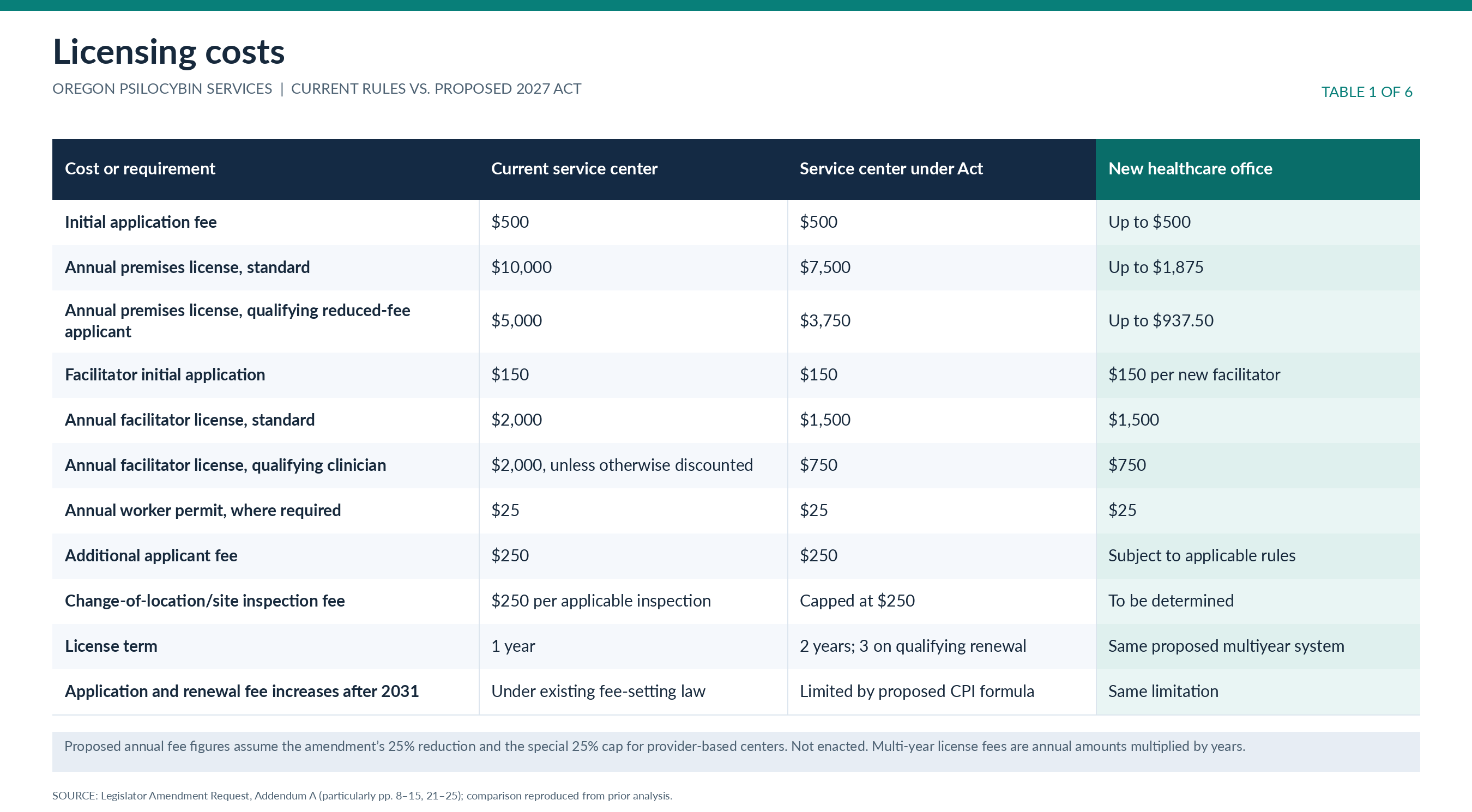
Click the image to view the full-size table.
02 · Buildings, location, and zoning
Licensed premises, land-use restrictions, school setbacks, shared facilities, and floor plans.
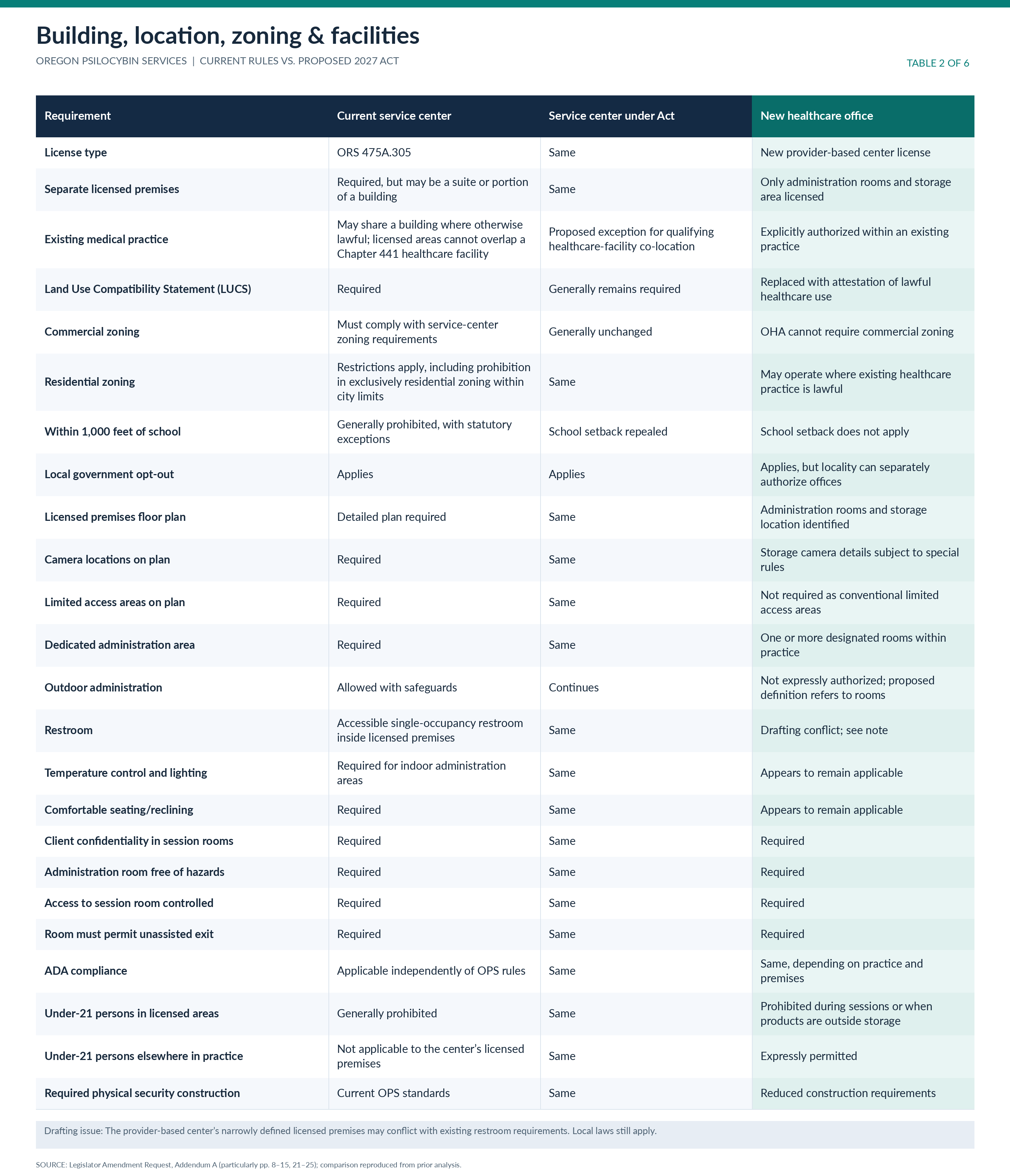
Click the image to view the full-size table.
03 · Security, surveillance, and storage
Alarm systems, video coverage, secure storage construction, access, and inventory limits.
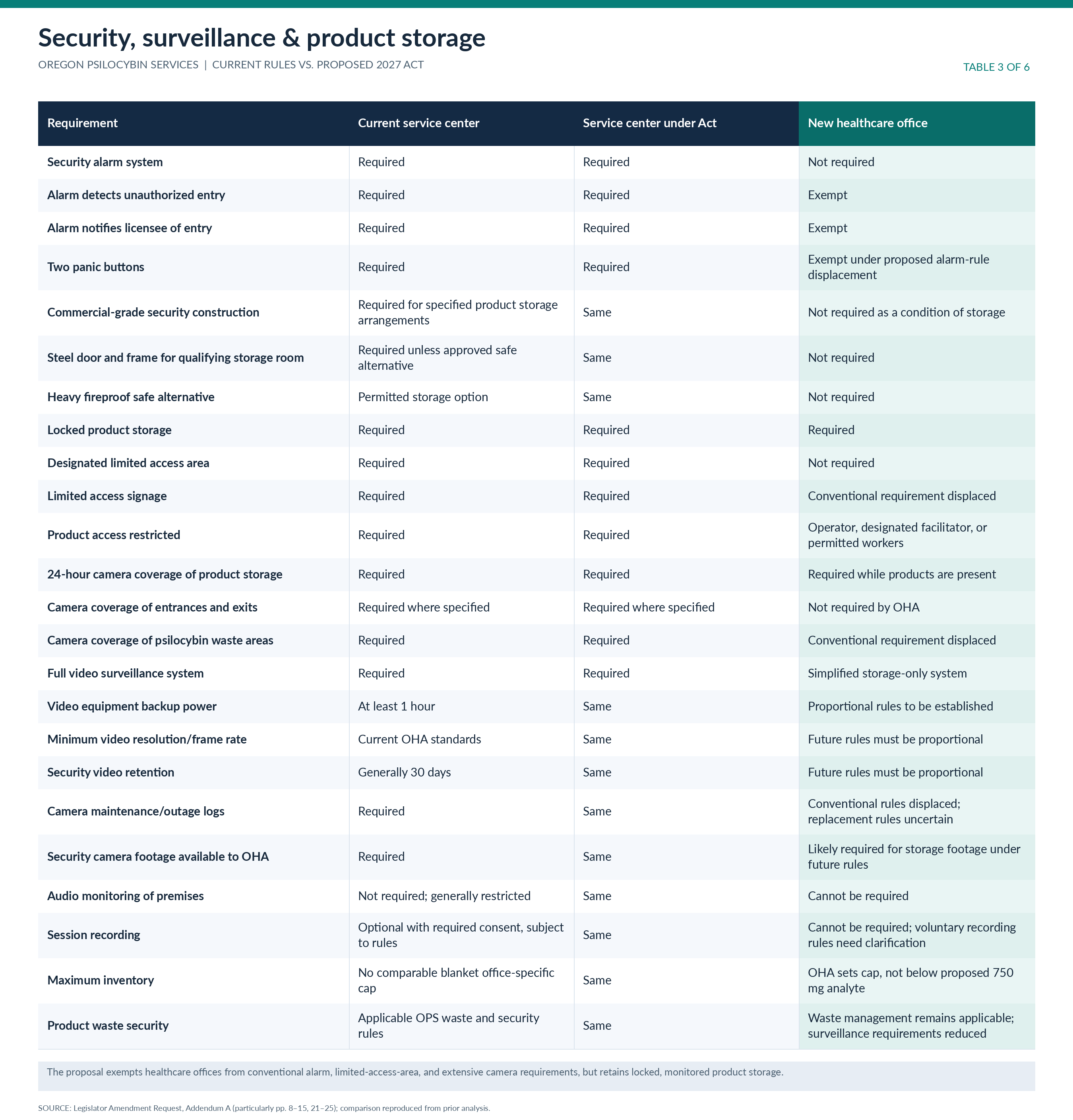
Click the image to view the full-size table.
04 · Staffing, clients, and sessions
Staff presence, facilitator qualifications, existing patient relationships, and administration rules.
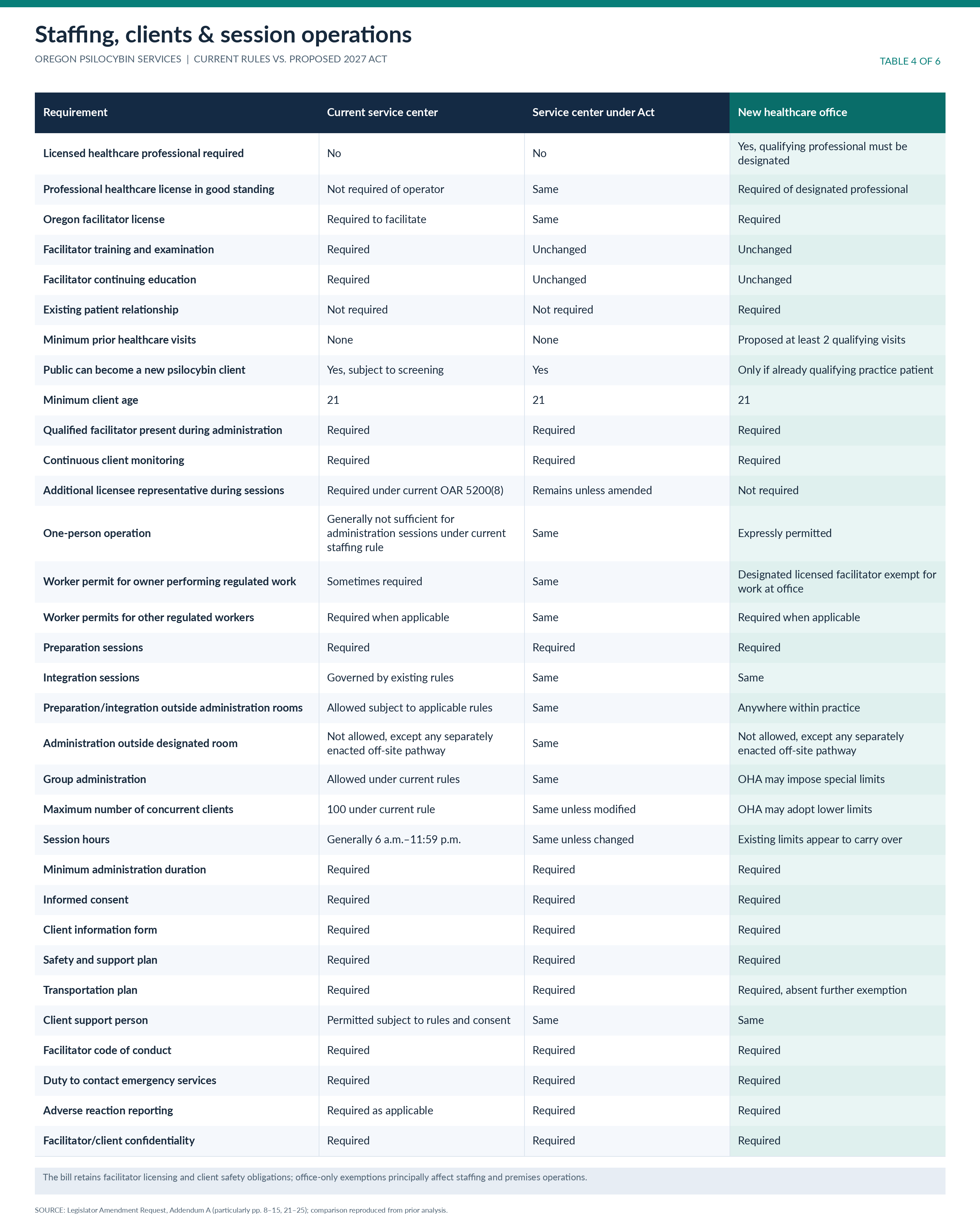
Click the image to view the full-size table.
05 · Product sales, tax, and reporting
Product custody, sales, tax obligations, client records, tracking, and reporting.
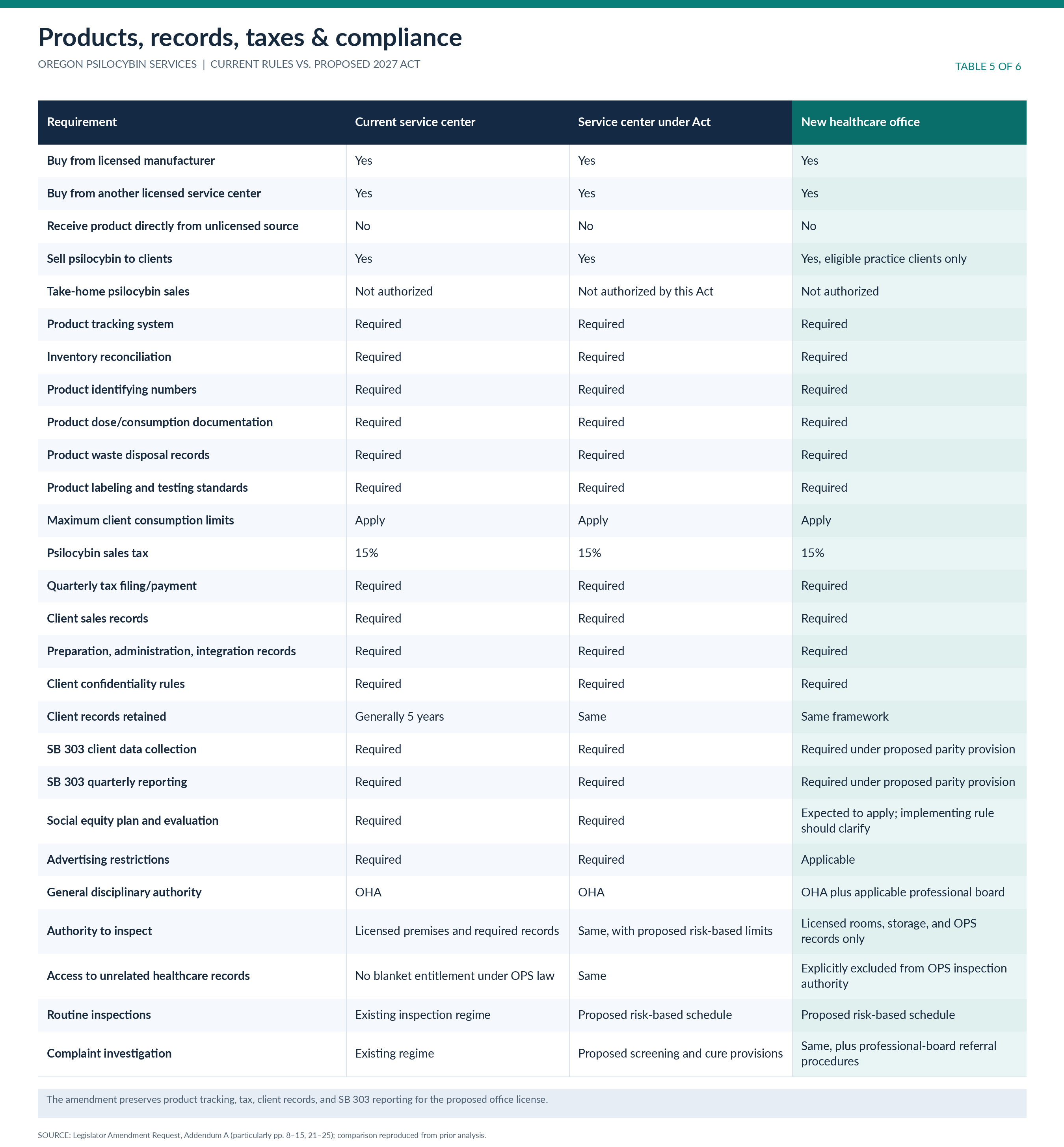
Click the image to view the full-size table.
06 · Operating expense categories
Potential differences in labor, facility overhead, security equipment, and compliance expenses.
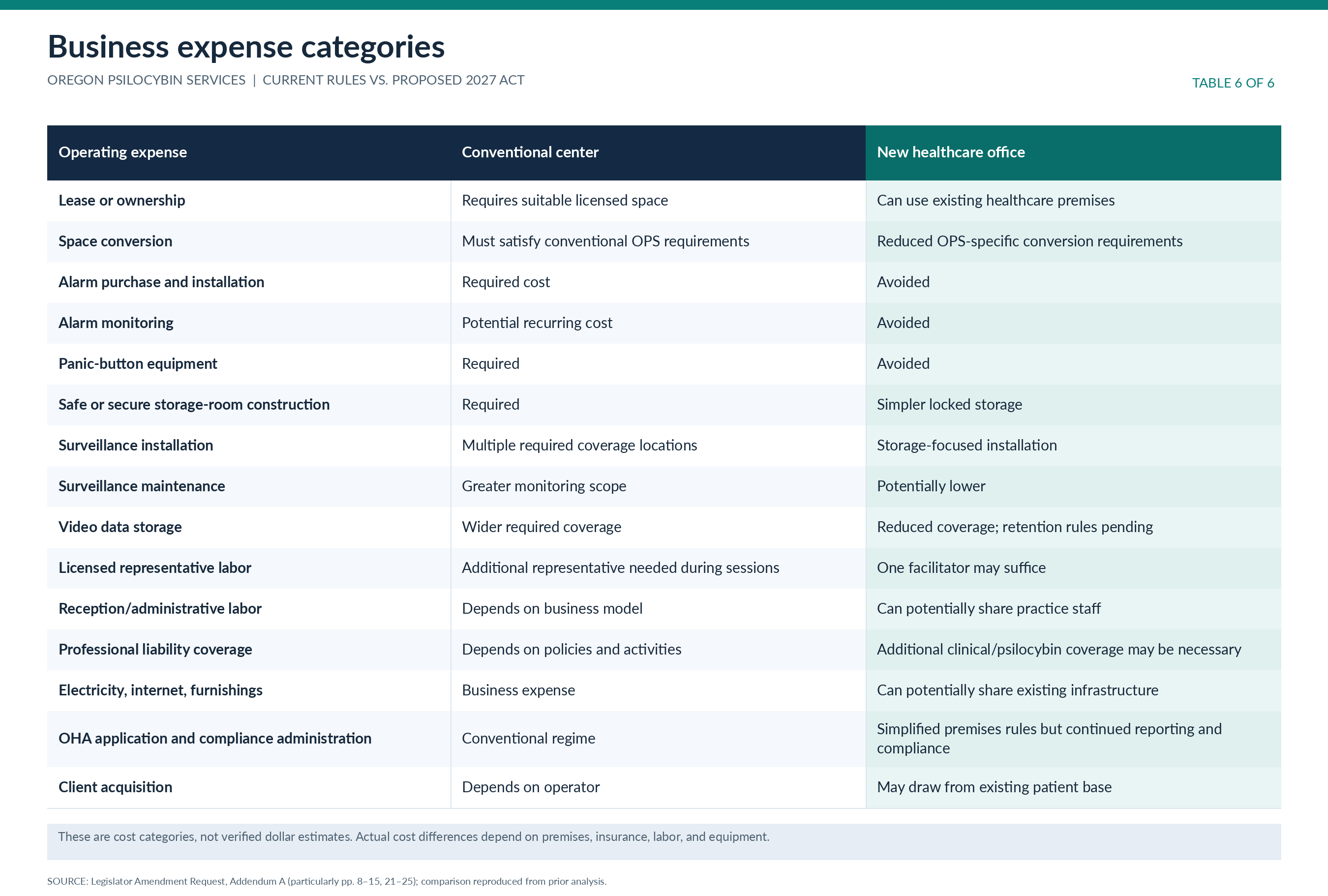
Click the image to view the full-size table.
Three areas of change
Regulatory costs
Proposes lower licensing fees, longer license terms, risk-based inspections, and a target for program administration spending.
Access to services
Would allow qualifying in-home sessions and create a separate provider-based license for healthcare practices.
Oversight and safeguards
Would change complaint screening and certain agency responsibilities while preserving core facilitator and client protections.
Nine directions in the amendment request
The request sets out nine broad legislative directives. The detailed Addendum A should control if the introductory summary and later drafting notes differ.
01 · Complaint screening
Written screening before investigations; notice-and-cure treatment for certain technical deficiencies.
02 · Licensing fees
Proposed fee ceiling, license-fee reductions, reduced-fee categories, and limits on later increases.
03 · Licenses and inspections
Two-year licenses, potentially three on qualifying renewal; risk-based routine inspections.
04 · Qualifying in-home sessions
A pathway for eligible clients who cannot reasonably travel to an established service center.
05 · Healthcare offices
New provider-based center license for existing clinical practices under distinct facility rules.
06 · School setbacks
Would repeal the statewide 1,000-foot school setback for conventional service centers.
07 · Agency responsibilities
Transfers manufacturing and laboratory licensing, inspections and discipline to OLCC in 2028. OHA would retain laboratory accreditation and testing standards.
08 · Program spending
Sets a proposed administrative-cost target and legislative reporting duties.
09 · Unchanged protections
Preserves facilitator credentials, core ethical standards, supervised use, and product safeguards.
Manufacturers and testing laboratories: OLCC oversight
Under Directive 7, the Oregon Liquor and Cannabis Commission would assume licensing, renewal, inspection, investigation, discipline, and relevant worker-permit functions for psilocybin manufacturers and testing laboratories beginning January 1, 2028. OHA would continue overseeing service centers and facilitators.
This is a proposal, not current law. Laboratories would still require OHA/ORELAP accreditation.
Manufacturers
OLCC would regulate: manufacturer premises licenses, application and renewal procedures, inspections, investigations, discipline, worker permits, and manufacturing-related packaging and labeling requirements.
Still required: manufacturing endorsements, applicable product-testing and product-safety requirements, and existing license obligations unless specifically amended.
Transition: OHA-issued manufacturer licenses would remain valid through their existing terms.
Testing laboratories
OLCC would regulate: laboratory premises licensing, renewal, inspections, investigations, discipline, and applicable worker permits.
OHA/ORELAP would retain: laboratory accreditation and oversight of the accreditation process. A laboratory would still need both accreditation and a premises license.
Testing: existing statutory testing standards would remain with OHA; the proposal does not eliminate required product testing.
Other changes affecting manufacturers and laboratories
Several other provisions apply across license types, not just to healthcare offices.
License fees
Manufacturer and laboratory license/renewal fees would be set at 75% of January 1, 2026 levels: $7,500 annually rather than $10,000 for a standard license. Qualifying reduced-fee applicants could pay $3,750. ORELAP accreditation fees are separate.
Longer license terms
The proposed system provides two-year licenses and three-year renewals for qualifying licensees. Annual license fees are multiplied by the term length and may be paid in annual installments.
Risk-based inspections
Routine inspection frequency would reflect compliance history and risk. Qualifying compliant premises could avoid routine inspections during a renewal term; for-cause inspections would remain available.
Product tracking
ORS 475A.400 would be amended to require the OLCC tracking system rather than an alternative OHA system. Implementation and transition details would need rules and coordination.
Worker permits and records checks
Worker permits would move to proposed five-year terms. The bill proposes reusing a qualifying fingerprint-based background check for up to five years across applicable licenses and permits.
Complaint screening and costs
Written complaint screening, notice-and-cure procedures for certain deficiencies, limits on investigations, and fee/spending accountability would also shape oversight. The OLCC/OHA coordination details need careful drafting.
Important distinctions: Packaging and labeling oversight associated with manufacturers would transfer to OLCC, with specific retained OHA authority. Testing standards and ORELAP accreditation would remain with OHA. License fees and civil penalties would continue flowing to the Psilocybin Control and Regulation Fund, not the marijuana fund. The amendment does not authorize take-home product or remove testing requirements.
Drafting clarification: Addendum A contains an OLCC transfer directive, while a later timing note says the directive is absent; that inconsistency must be resolved in the introduced bill.
Source: Amendment request, Addendum A, Directive 7 (pages 27–28), fee provisions (pages 8–12), license/inspection provisions (pages 13–17), and timing (pages 31–32).
Provision 5: Provider-based psilocybin therapy centers
The amendment would create a distinct premises license allowing a qualifying healthcare or behavioral healthcare practice to offer psilocybin administration sessions at its existing location.
A designated professional must hold both a qualifying healthcare credential and an Oregon facilitator license. The proposal also includes lower premises fees, simplified security requirements, and the ability to operate with a single licensed facilitator.
Key qualification
Clients must already have a genuine therapeutic relationship with the practice, proposed as at least two qualifying prior healthcare visits that are not undertaken merely to establish psilocybin eligibility.
The bill does not authorize take-home psilocybin or unsupervised administration.
Questions for policymakers and licensees
The proposed provider-based license would preserve many OPS obligations but use distinct facility, staffing, and fee requirements. These are specific questions raised by the comparison.
Staffing standards
When can an administration session be conducted by one licensed facilitator without an additional representative, and should the same rule apply across premises types?
Product security
If a limited-inventory healthcare office may use locked, video-monitored storage, what comparable safeguards should apply to a conventional center with similar inventory?
Fees and oversight
How should different licensing fees correspond to the actual state oversight cost, size, and risk profile of each regulated premises?
If enacted: proposed timeline
2027 or upon the Act’s effective date: Fee provisions and repeal of the statewide school setback are drafted to operate earlier, subject to final legislative language.
January 1, 2028: Proposed operative date for provider-based healthcare offices, qualifying off-site services, and multiyear licensing and inspection reforms.
Core protections remain
The draft does not authorize unsupervised administration, take-home psilocybin, new controlled substances, or elimination of facilitator education, examination, and ethical standards.
Product tracking, sales tax, client records, and applicable reporting remain part of the proposed framework.
Read the source document
The analysis is based on the Legislator Amendment Request — Psilocybin Services Improvement Act, dated September 8, 2026, especially Addendum A, Provision 5 (pages 21–25) and Directive 7 (pages 27–28). Its instructions are proposals for Legislative Counsel, not enacted statutory text.
Important: The House Bill number is pending. Dollar figures for future licenses and differences in operating expense are proposed or illustrative; actual requirements and fees could change during drafting and passage.
Help shape what comes next
Oregon licensees, facilitators, healthcare professionals, and supporters can help inform a safe, accessible, and economically sustainable psilocybin program.